Short answer: Emergency tree work gets dangerous weight off a house, vehicle or driveway safely, usually the same day. Call as soon as the tree is down, keep everyone away from any wire, and photograph the scene for your insurer. Valley-wide storm calls are triaged by severity, with trees on structures first.
When Is Storm Season in the Fraser Valley?
From October through February, the Fraser Valley sits in the path of Pacific frontal systems and atmospheric rivers. The pattern repeats every year: weeks of rain saturate the ground until root plates float in soft soil, then a windstorm arrives with southeasterly gusts channelled down the valley, or an Arctic outflow roars the other way through the eastern communities. That is when the region's giant conifers fail. Cedars snap at weak points mid-trunk, shallow-rooted hemlocks and saturated firs uproot whole, and heavy wet snow or silver thaw loads branches past their breaking point. Every valley resident has seen the aftermath: a fir across a roofline, a cedar through a carport, a road closed by a fallen giant.
We spend every storm season getting trees off houses, driveways, fences and vehicles across Abbotsford, Chilliwack, Mission and Langley. Here is how it works and what to do while you wait.
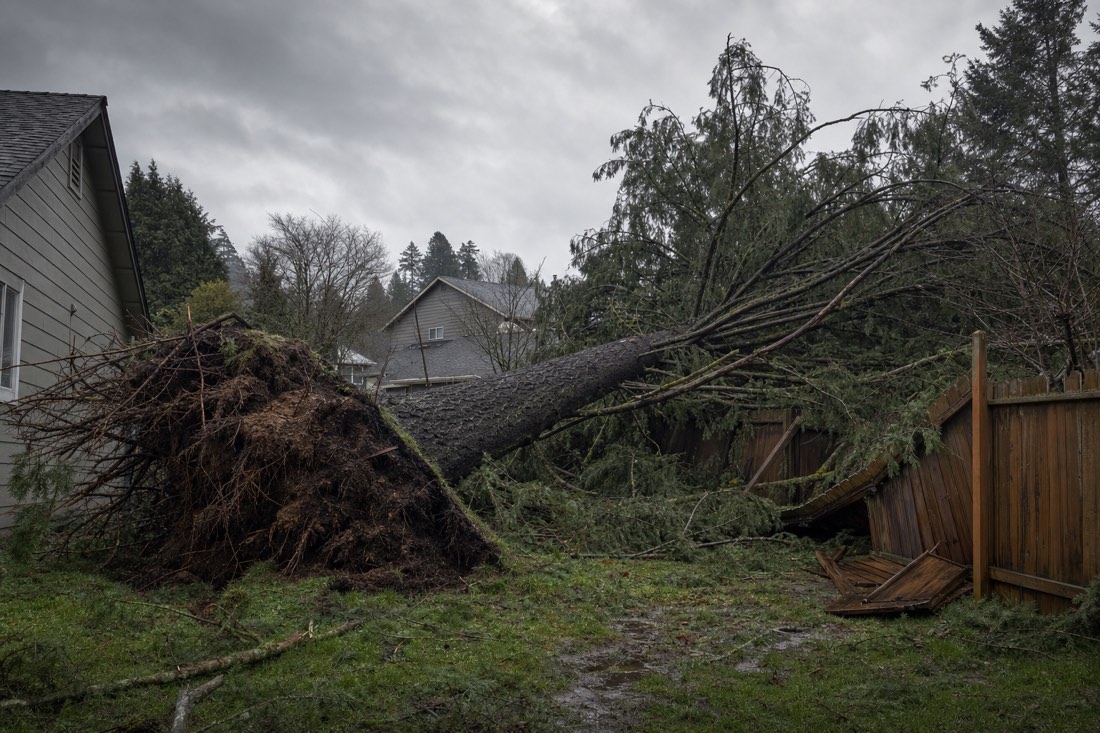
What Counts as a Tree Emergency?
Anything where the tree is now loaded against a structure, a vehicle, a wire or your only way out. If one of the situations below describes your property, call rather than wait for the weather.
- Tree on a structure: house, garage, carport, shop or mobile home, whether or not it has broken through
- Tree on a vehicle or blocking your only driveway access
- New lean or lifted root plate: the tree has started to fail but has not finished
- Hung-up broken limbs (widow-makers) suspended over areas people use
- Split or cracked stems on trees standing over targets
- A tree against or into power lines: this one is BC Hydro's call first, see below
What Should You Do Before the Crew Arrives?
- People first. Clear everyone out of rooms under the tree. If the structure took a major hit, get out of the building entirely.
- Assume lines are live. If any wire is down or the tree touches a line, stay back at least 10 metres and call BC Hydro (1-888-769-3766). No tree work happens near energized lines until BC Hydro makes it safe.
- Do not cut or pull anything. A fallen tree on a structure is loaded with tension and compression in ways that are not visible. Chainsawing a loaded stem, or dragging it with a truck, is how storm injuries happen after the storm.
- Photograph everything. Wide shots and close-ups, before anything is moved. Your insurer wants them and so do we.
- Tarp only what you can reach safely from inside or from a ladder on solid ground, and only if the tree is stable. A wet roof under a loose conifer is no place to be.
- Call us with your address, what the tree is on, and whether wires are involved. Photos by text speed up triage enormously.
How Is a Tree Removed From a House?
A tree on a structure is removed in the reverse order it landed: weight comes off the top and outer sections first, in small rigged pieces, so the load on the building decreases at every cut and nothing rolls or shifts. Where the stem is large or dangerously loaded, a crane lifts entire sections straight up and away, which is often the fastest and gentlest option for the building. Once the tree is off, we coordinate with your restoration contractor's tarping and board-up, and the remaining trunk and debris are bucked, chipped and cleared like any removal. Throughout, we photograph the work and provide the documentation insurers ask for: date-stamped images, a description of the failure, and a detailed invoice.
What Should You Check After the Storm?
The dramatic failures get the headlines, but the week after a storm is when the subtle hazards need attention. Broken limbs hang in canopies waiting for a calm sunny day to fall. Cracks opened in stems and unions that will fail in the next event. Trees that moved in the soil now stand at a slight new angle. After every major blow, it is worth walking your property and looking up: at hangers, fresh cracks, tilted stems and newly cracked soil at the base of big trees. Anything suspicious, send us a photo. A post-storm danger tree assessment catches the failure that was postponed, not prevented, by the storm ending.
How Do You Avoid the Next Emergency?
Deal with the tree that already worries you, in dry weather, before October. Planned removals and reductions cost a fraction of the same tree handled as a storm callout.
Nearly every storm callout we attend had warning signs: a dead top visible for years, a lean the owners "kept an eye on," fungal conks at the base, a cedar hedge left to become a row of top-heavy trees. Pre-season work is dramatically cheaper than emergency work: a hazardous tree removed on a dry September day costs a fraction of the same tree craned off a roof in November, before counting the roof. If any tree on your property makes you nervous when the wind warning comes out, that is reason enough for an assessment. Book it in the calm season and storm nights get boring again, which is the goal.
Storm & Emergency FAQs
A tree just fell on my house. What do I do first?
Get everyone out of the rooms under the tree, and out of the house if there is structural damage, then call us and your insurer. Do not climb on the roof or pull at the tree; a fallen conifer is under enormous tension and can shift. If any power line is involved, stay well back and call BC Hydro at 1-888-769-3766 before anything else.
Is emergency tree removal covered by insurance?
Usually yes when the tree has damaged an insured structure: most home policies cover removal of the tree from the structure and the repair, subject to your deductible. A tree that falls in the yard without hitting anything is often not covered. We photograph everything before and during the work and provide detailed invoices that insurers accept.
How fast can you get here during a storm?
Trees on houses and blocked driveways come first, and during a storm event we triage calls across the valley in that order. In a typical event we reach structure emergencies within hours. Widespread events like a major atmospheric river or the 2021 flooding stretch every crew in the region, which is why the queue order is severity, not call order.
The tree is leaning but has not fallen. Is that an emergency?
Treat a new lean seriously: it means roots have failed and the tree has started to go. Cracked soil or a lifted root plate on the upwind side confirms it. Keep people, cars and pets out of the fall zone and call us the same day. A newly leaning conifer over a target is the one situation where waiting for the next windstorm is a genuinely bad plan.
A branch is hanging broken in my tree. Can I leave it?
No, hung-up limbs (widow-makers) should come down promptly. They are held by friction and bark, and they release without warning onto whatever is below, often days or weeks after the storm. Getting a hanger down safely is quick work for a climber and is one of our most common post-storm calls.
What if the tree fell from my neighbour’s yard onto my property?
Generally in BC, each owner claims damage on their own property through their own insurer, regardless of whose tree it was, and the insurers sort out any recovery between themselves. Liability can shift if the tree was a known, documented hazard the owner ignored. Document the scene with photos before cleanup and let the insurers argue about it.